

Why creative people struggle with consistency (and what actually helps)
A reframe of the conversation creative people keep having with themselves about showing up. A guest post by Kathryn Vercillo.


As creatives, the struggle to stay consistent with our art practice is very real! No matter how many systems we set up and how many good intentions we have, somewhere along the way, our practice falters. It could be caused by an artist’s block, life getting in the way, or the simple fact that artists need time to refill our wells — but for most of us, the struggle is real. This guest post by Kathryn Vercillo helps us reframe the conversation we have about consistency and showing up.
Why creative people struggle with consistency (and what actually helps)
If I had a dollar for every creative person who has told me their problem is discipline, I could fund a small research grant. The discipline conversation is everywhere in creative culture. Show up every day. Protect your creative time. Build the habit. Make it non-negotiable. The advice has the quality of settled wisdom, repeated with such confidence and frequency that questioning it can feel like questioning gravity.
I have spent twenty years interviewing artists, writers, and makers about the relationship between their health and their creative work, and what I keep finding at the center of the consistency struggle is something the discipline frame consistently misidentifies. It isn’t designed for most people. It certainly isn’t designed for me, although it took me years of learning about my needs and my rhythms and how to be gentler to myself to really get that.
What consistency actually requires
Consistent creative output requires consistent capacity. Capacity requires, at minimum, some degree of stability across the domains that make creative work accessible: physical vitality, cognitive clarity, emotional bandwidth, time, and the psychological sense that making is safe and worthwhile. When those conditions fluctuate, and they fluctuate for everyone, creative output fluctuates with them. This is a mechanical relationship, as direct as the relationship between fuel and motion.
For people navigating chronic illness, neurodivergence, significant caregiving responsibilities, financial precarity, grief, or major life disruption, that fluctuation is often dramatic. The baseline from which creative work is supposed to happen is itself unstable. Expecting consistent output from an unstable foundation and interpreting the gap between expectation and reality as a character deficiency is an extremely common and extremely costly misdiagnosis.
What changes when you name this accurately is the question you ask. The question shifts from “why do I have so little discipline?!“ to “what are the actual conditions of my creative life, and what kind of practice can genuinely be built around them?“ It shifts essentially from “what’s wrong with me?” to “how do I do what’s right for me?”
What fluctuating capacity actually is
Capacity is the sum of what is available to bring to creative work on any given day. Let’s look closer at the components I named above … Capacity includes physical vitality and cognitive clarity. It includes emotional bandwidth, which is the internal resource that allows you to tolerate the vulnerability and uncertainty that creative work consistently requires. It includes time, and the quality of that time: time that is genuinely uninterrupted and mentally available is a different resource from time that technically exists but is saturated with other demands. And it includes the psychological dimension: the felt sense that making is safe, that the work is worth attempting, that you are someone who does this.
All of those dimensions vary. For everyone, across every kind of life. The image of a creative person with reliably stable capacity across all of them, day after day through every season of a life, is a fiction that has produced an enormous amount of unnecessary suffering in the real creative people who have tried to measure themselves against it.
Mihaly Csikszentmihalyi’s research on flow states, the experiences of deep creative absorption that most makers recognize and seek, identified something important about the conditions those states require. Flow emerges when the challenge of the work matches the capacity of the person engaging with it, not slightly below and not far above, but in a zone of genuine stretch that the person’s current capacity can actually reach. When capacity drops, the zone shifts. Work that was accessible becomes inaccessible. The creative person who tries to enter a flow state from a position of significant depletion is trying to reach something that has moved, and no amount of discipline relocates it.
The specific harm in the discipline frame
The discipline frame carries a particular harm embedded in its logic. When the source of creative inconsistency is located in willpower and character, then every period of low output becomes evidence against the person. Every week where making was inaccessible becomes a data point in a case being built, slowly and persistently, against the creative self. The story compounds over time: you are not serious enough, committed enough, willing enough to do what the work actually demands.
Shame and self-criticism are, across the research literature, among the least effective motivators for sustained creative engagement, and among the most reliably counterproductive ones for people whose nervous systems are already under significant load. The person struggling to make things because of health-related depletion carries an additional burden when the depletion is reframed as moral failure. The burden makes the depletion worse. The worsened depletion produces less creative output. The less creative output produces more shame. The pattern compounds in a direction that serves no one.
What the research shows about sustainable practices
The creative practices I have seen sustain themselves over decades, in the people I have interviewed and in my own life, share recognizable qualities. They are built around actual rhythms rather than idealized ones. They include genuine flexibility and genuine recovery. They treat low-capacity periods as information about what the body and nervous system require, and they respond to that information rather than overriding it. They have a realistic relationship to what consistency means for the specific person in the specific conditions of their life, rather than importing a consistency standard from someone else’s life and applying it universally.
For one person, a sustainable practice is twenty minutes every morning. For another, it is intensive multi-week periods of making separated by longer fallow stretches. For another, it is seasonal: gathering in autumn, receding in winter, returning in spring with something new accumulated during the apparent absence. For another, it is a practice that reorganizes itself around the rhythms of a chronic illness, making the most of higher-capacity periods and releasing the demand for output during lower ones. For most of us, it is more than one of these things over a lifetime.
None of these is the universally correct form of creative practice. All of them can be genuinely sustainable. The criterion for sustainability is whether the practice is built around what is actually true about the person’s life and body and capacity, or whether it is built around a vision of how things should ideally be.
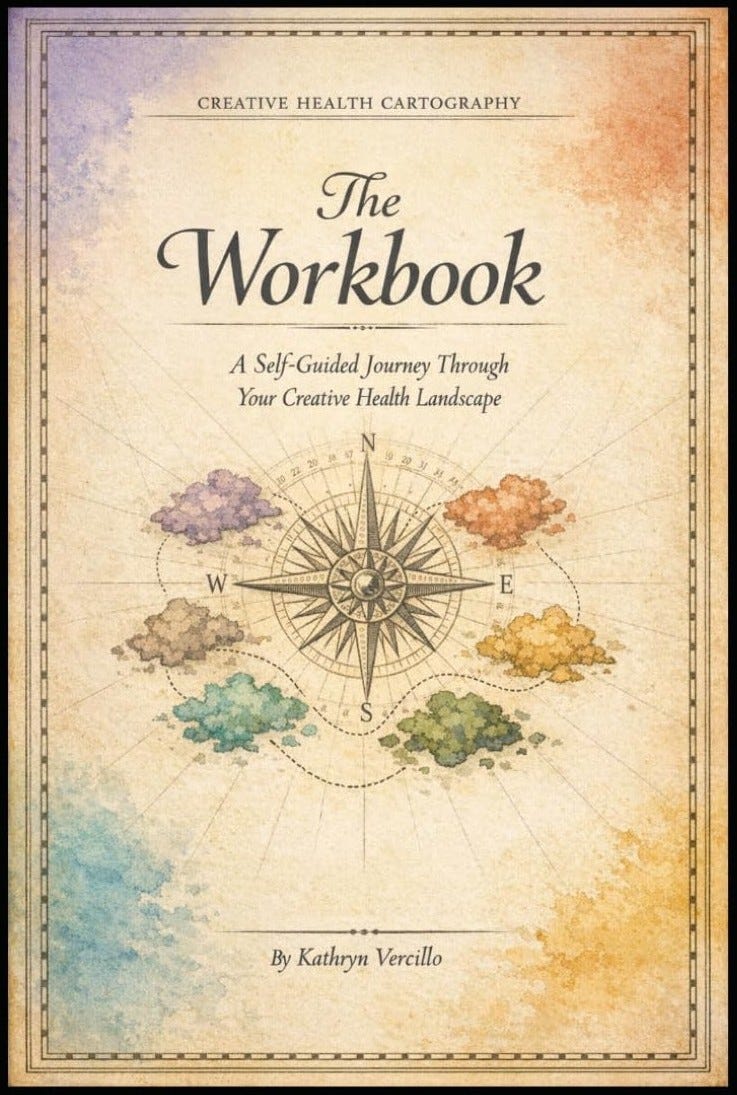
The Creative Health Cartography workbook includes exercises designed to help you map your actual rhythms with specificity: when creative capacity tends to be available, what tends to consume it, what tends to restore it, how the patterns shift across seasons and stress levels and physical states. That mapping produces actionable self-knowledge rather than generic advice, because the advice that applies to your situation is always going to be more specific than anything a general framework can generate for you.
What discipline can actually do
Discipline, understood accurately, is the capacity to return to creative work across time, to maintain a practice through difficulty, to prioritize making in a life full of competing demands. That is real and it takes genuine effort, and it matters. The reframe here is about what discipline is applied to rather than whether it matters at all.
Discipline applied to conditions genuinely within your control … the choice to sit down when capacity is available, the practice of protecting certain conditions that make creative work accessible, the willingness to show up even when the output is uncertain: this is discipline being used well.
Discipline applied to conditions outside your control … to a body in a flare, to a nervous system in shutdown, to a life in genuine crisis, produces effort without return and blame without accuracy. Understanding the difference between what is within your influence and what requires a different response than harder pushing: that is the work the workbook supports.
The answers are already within you. I hope that the workbook helps you see them more clearly.
This is a guest post from Kathryn Vercillo as part of her Creative Health Cartography Workbook tour. Follow the full tour at createmefree.substack.com. If you liked this piece, you might also like to read:

The Creative Health Cartography Workbook is a self-guided framework for understanding how your health shapes your creative life. Built from 20 years of research and interviews with more than 100 artists, writers, and makers, it works through 6 domains of creative practice with reflective exercises, composite real-world stories, and a 6-archetype pattern system. Available as a PDF download and in print. Use the code WorkbookTour20 for a 20% discount on the PDF and physical copies signed-and-shipped-by-Kathryn (only for US shipping).
If you’d like company on your creative path, I send notes on creative living, pages from my art journal, and short process videos every Friday — small reminders that you don’t have to do it all alone.